Background & Context
Fibre flax production in Atlantic Canada is still developing, and local growing recommendations remain limited. Although fibre flax was historically grown in the region, production declined and much of the practical knowledge was lost. As interest in flax increases, there is a need to rebuild region-specific knowledge. This research will develop practical guides and best-practice recommendations to support future grower adoption and to share with partners such as Perennia and the Nova Scotia Department of Agriculture.
Methodology
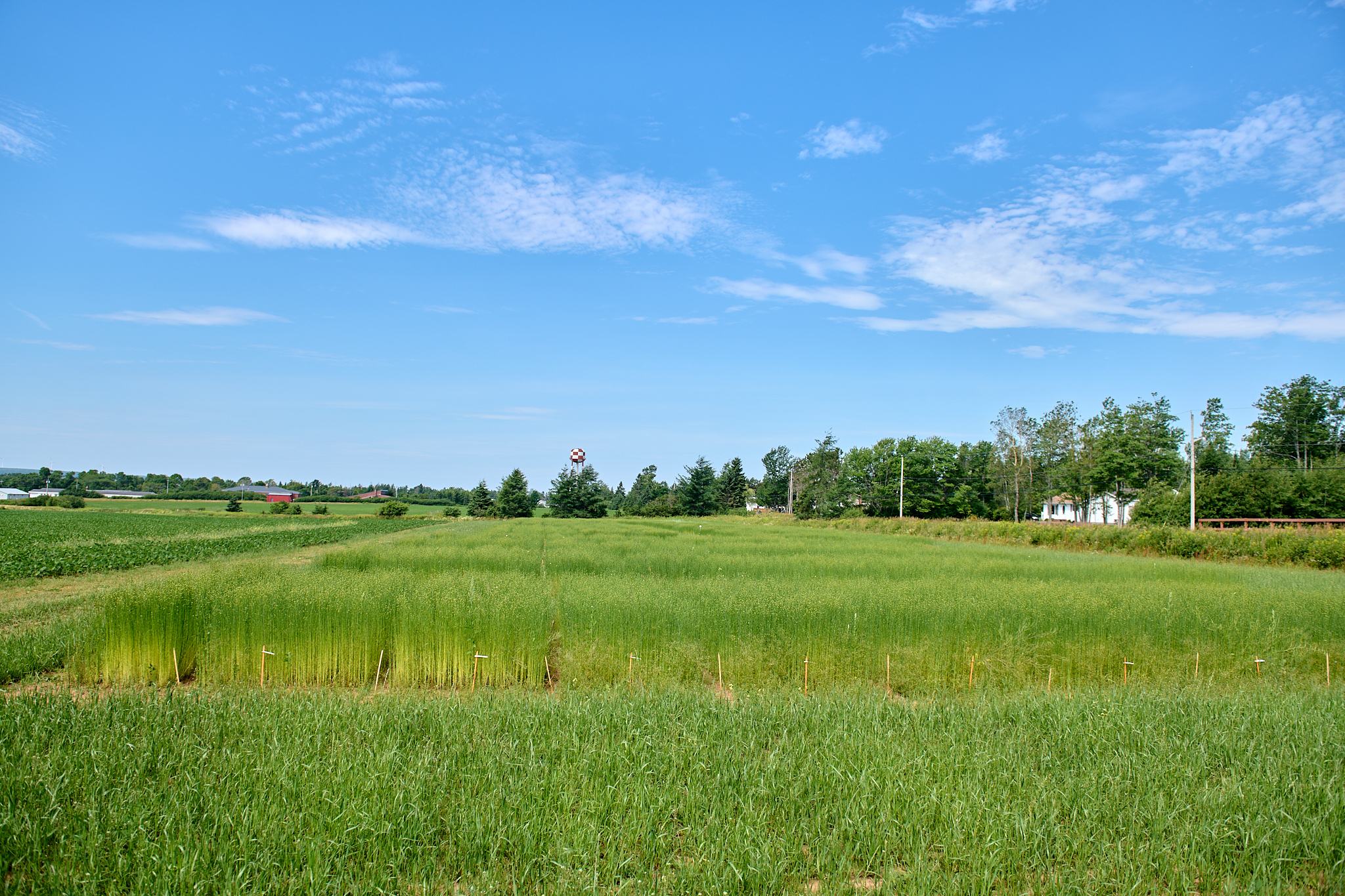
Field research trials were conducted to evaluate key farming practices that influence crop establishment, growth, and fibre yield. Treatments included seeding method and rate, organic fertilizer levels, weed management approaches, cover crop treatments, and seeding timing comparisons. Plots were monitored throughout the growing season for crop emergence, plant density, plant height, and crop development. Trials were conducted at Dalhousie University and across multiple grower sites to allow the research team to understand how weather, soil, and management practices affect flax production and fibre quality under real growing conditions. This research helps develop practical recommendations that improve flax performance under local conditions.
Key Findings
Preliminary results to date show that reasonable yields of flax for fibre can be produced in Nova Scotia, with a high variability among sites depending on field history and fertility status. We have found that flax has been responsive to nitrogen fertilizer, producing thicker stems and higher yields, however, this may also reduce quality. Broadcast seeding was fairly consistent in producing higher yields compared to seeding at 15 cm row spacing, especially if there was rain shortly after seeding. Seeding cover crops with the flax seeding was problematic. Higher seeding rates did result in higher stem density and thinner stem diameter, but needs further study.